

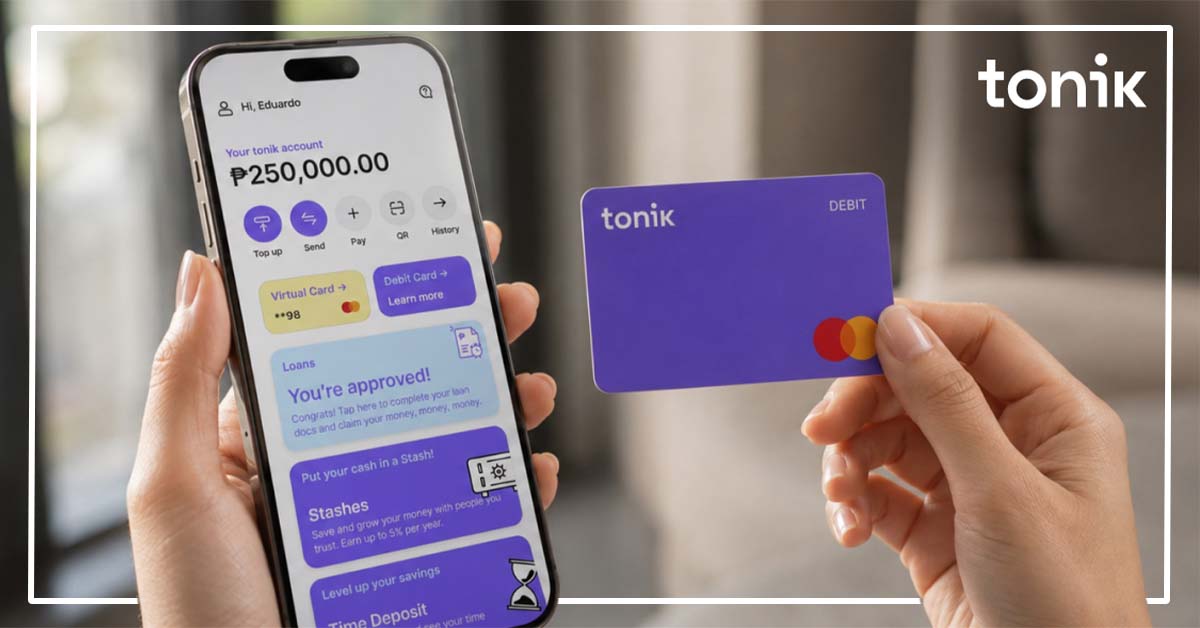
In a country where digital banks have often been measured by flashy user numbers and deposit volumes, Tonik has quietly rewritten the playbook. The Philippines’ first standalone digital bank, and holder of BSP Digital Banking License No. 001, has reached sustained profitability. In the first quarter of 2026, Tonik generated consolidated positive cash net income (after all costs, including risk), making it the first standalone digital bank in the country to do so. Its regulated bank subsidiary, Tonik Digital Bank, Inc., also achieved IFRS profitability for the entire quarter. Globally, Tonik now stands among the fastest non‑ecosystem neobanks to reach this point!
This achievement is not the result of chasing vanity metrics, though. Here’s how they did it:
From day one, Tonik made a deliberate choice to build a credit‑led institution, not a user platform. While much of the Philippine digital banking narrative has revolved around user growth and payment volumes, Tonik focused on deploying capital efficiently into consumer credit, targeting the 90% of Filipinos who remain unserved by formal bank lenders.
Five years later, that discipline paid off. Tonik’s profitability is proof that building on lending productivity, rather than idle deposits or user accumulation, creates stronger and more sustainable economics.
As of April 2026, Tonik’s loan portfolio has reached USD 110 million, growing 2.3× year‑on‑year and cementing its position as a growth leader. Its annualized revenue run‑rate now exceeds USD 60 million, with a staggering 99% of that coming from lending. Net interest margin and lending RAROC stand at 51% and 25%, respectively, the highest in the Philippine banking market. The loan‑to‑deposit ratio is at 82%, again the highest among digital banks in the country. And perhaps most telling of its efficiency, Tonik’s net LTV/CAC ratio is 23×, validating a scaled upsell flywheel engine that continues to accelerate.
Why This Model Matters
Tonik’s profitability is particularly significant because it was achieved without leaning on a pre‑existing ecosystem. No telco, no payments platform, no retail giant backing it up! While ecosystem‑backed models can accelerate early growth, they often cap scalability in the long run. Tonik’s standalone, balance‑sheet‑driven approach mirrors the path taken by many of the world’s largest digital banks, proving that independence can be a strength when paired with disciplined lending.
Three structural decisions underpin Tonik’s success. First, AI‑driven risk management has been refined over five years of data and underwriting iteration, enabling profitable lending even to thin‑file borrowers. This has improved risk‑adjusted returns while sustaining growth. Second, portfolio mix diversification has spread lending across employer‑channel salary‑deduction loans, merchant installment networks, and digital personal loans. This diversification provides structural risk mitigation and supports de‑risked unit economics. Third, Tonik’s deposit advantage, enabled by its BSP license, allows retail funding at 3–6%, compared to 15%+ for non‑bank lenders. This creates a structural margin edge on every loan, giving Tonik a competitive advantage that compounds over time.
“Profitability in digital banking is a function of what you choose not to do. We chose not to chase users as a vanity metric. We chose not to build deposits we couldn’t deploy. We built a credit bank—with the best unit economics in the market—and let the income statement follow,” shares Greg Krasnov, Founder & CEO of Tonik Digital Bank. “We are now the only player that is both cleanly profitable and structurally positioned with a digital bank deposit license to scale into the $50-100 billion credit gap. That makes us the growth leader today. That is a rare combination, and we intend to press it.”
Tonik now enters its next phase as the loan portfolio growth leader among Philippine digital banks. With profitability achieved, it no longer requires external subsidy to grow. Near‑term priorities include expanding employer‑channel lending through Tendo, scaling its merchant network, and enhancing revolving credit products to serve a repeat borrower base. The goal is to accelerate lifetime customer value through a flywheel effect that keeps borrowers engaged and returning.
Congratulations, Tonik!
For updates on our latest discoveries within (and outside) the Metro, don’t forget to follow Manila Millennial on Facebook, YouTube, TikTok, or Instagram
Nice congratulations tonik
Sure na marami din ang tatangkilik sa digital banking na Ito
Ang ganda pala nitong Tonik and Congratulations 👏👏